
Those of us who enjoy pre-war machines probably know that brake lights only became compulsory – on new motorcycles – from 1st January 1936. However, they are a ‘useful’ feature on older machines. After all, explaining that the car behind ran into you because your motorcycle hasn’t got a stop light doesn’t look good on an insurance claim!
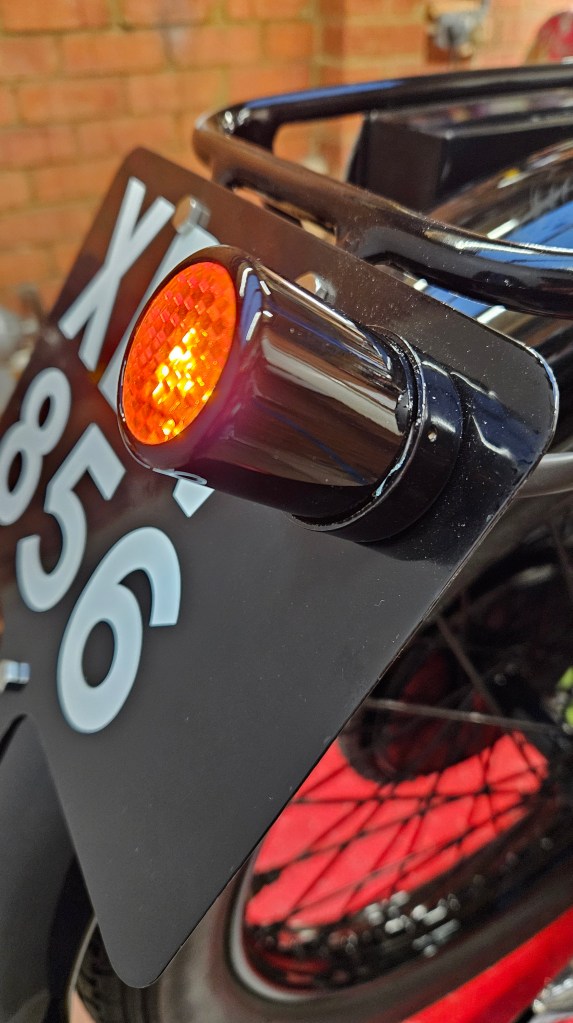
In restoring my own 1931 Douglas, I’ve tried to keep its appearance as authentic as possible. It had a period rear light but it was damaged and the red lens was missing – and it only had provision for a single filament tail lamp bulb. The lens was the easy bit – cut down from a bicycle reflector. Modifying the lamp housing to take a twin filament bulb for stop and tail lamps was more challenging. Eventually I bought a pattern ’30s style rear lamp and carefully removed the bulb holder. I did the same with the old unit and then silver-soldered the new bulb holder into the old housing. As I had to make a wiring harness as well, it was a simple matter to include wiring for a stop lamp at the same time – and include an earth lead back to the battery.
So, now I had a newly repainted lamp, a lens/reflector with a stop and tail lamp bulb – but the brightness of the lamps was less than impressive. Time for another ‘modern’ compromise. After some research I found an LED stop/tail lamp bulb that was short enough (36 mm overall) to fit inside the housing. Not only does this give excellent brightness but, with a power consumption of 0.75 W, it makes a 20 W BTH pancake dynamo look muscular! Result – a 1931 motorcycle with a rear lamp that has reasonable performance for today’s roads.
 The London Douglas Motor Cycle Club
Its also worth pointing out that a modern lithium battery makes running lights without a generator a much more useful option than before.
To give you some idea of the change I have an electric start on my Vincent Comet which easily turns a 9.5:1 compression engine without a decompressor and the battery is unbelievably light and fits inside an old black EXIDE battery box it would drive a set of LED lights and coil ignition for longer than most journeys on a vintage Douglas would ever take.
LikeLike
If I recall correctly, stoplights didn’t become compulsory in the UK until the mid 50’s. I can remember my father modifying the wiring on his Norton combination to incorporate a stoplight. Also, postwar Douglases didn’t have stoplights fitted as standard until 1956, when the Dragonfly was made available with a modified rear brake pedal pivot that incorporated a lever to operate the switch. Early Dragonflies (1955) only had a single filament rear light.
LikeLike