Douglas Endeavour – under the Hammer

I don’t generally highlight machines selling at auction on this site – it feels a bit like free advertising, which is definitely not the Club’s role – but sometimes a machine comes along that deserves comment.
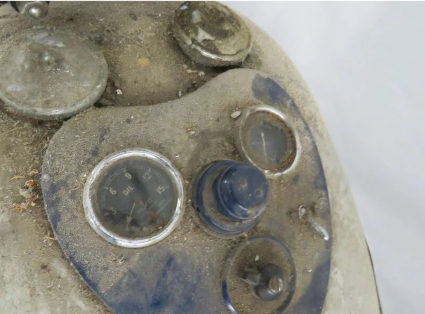
Douglas Endeavour 1936 Barn Find
1936 Douglas Endeavour in ‘Barn Find’ Condition

I wrote recently about two unusual ‘barn finds’; good things, they say, come in threes, so maybe this is the third. Iconic Auctions are selling a remarkably original 1936 Douglas Endeavour at their auction on 19th April 2026. CLX 301 was first registered in London, in March 1936 according to the DVLA website, and the auctioneers state that it has been in the same ownership since 1976. It is one of around 30 of this model known to the Club, and production estimates vary. One of the designers, Eddie Withers, estimated that around fifty machines were built; engine and frame numbers listed by the LDMCC suggest perhaps around one hundred. Whatever the figure, Douglas Endeavour motorcycles were an uncommon sight in the 1930s and are an even rarer one today.

For readers unfamiliar with the Endeavour, it was a shaft-driven transverse twin, a configuration more usually associated with BMW. Rushed into production in conditions of great secrecy in time for the London Olympia Show of November 1934, this radical new machine won plaudits from the motorcycling press of the day. At £72.10.00, the buying public were more sceptical; hand gearchange and side valves were already passé for a top of the range machine.

Whatever its merits and shortcomings, the Douglas Endeavour was an adventurous design for its time; one of the great ‘what ifs’ of the British motorcycle industry. If a Douglas Endeavour is on your list of must-have motorcycles – well, these opportunities don’t come along often …

Barn Finds – a Thing of the Past?

Over the (many) years that I’ve been involved with motorcycles, I’ve always assumed that, at some point, the supply of ‘barn finds’ would dry up. My own barn find – or, more accurately, hedge find – a 1939 Triumph Tiger 80, is still in regular use, but the days when you used to see these things stuck in hedges or poking out from behind garages and sheds seem long gone.

One of the commonest requests to the website involves a picture of a Douglas followed by ‘what is it, what is it worth and how do I find a new home for it?’ While I carefully avoid the second point, I can usually help with the first and the third, and an advertisement in the Club magazine often follows. While Dragonflys, Mark Series and Aeros are generally well represented, I’ve had a couple arrive recently that have been quite special. The first was an S6 – a sporting 600cc side-valve flat twin from 1930. Unusual but not rare, one might say. This one, however, is virtually a one-owner-from-new machine, essentially dry-stored since the 1970s, in time-warp condition and complete down to the very ‘period’ mascot attached to the steering damper knob! It will be a fascinating project and wonderful to see it back on the road.

1930 Douglas S6 Barn Find, Near Side
1930 Douglas S6 in ‘as found’ condition

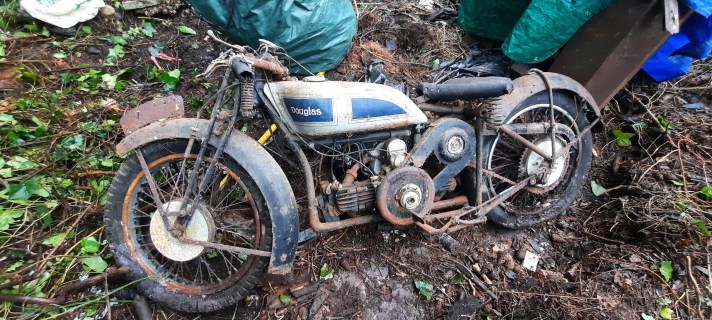
The second machine is decidedly unusual. It came to light following a house sale and was found under a collapsed shed. It is, I think, a model K32 – a 350cc machine from 1932, an overhead valve design made for one year only. The Douglas concern was in financial difficulties at this time, few of the overhead valve models were built and only a handful are known to the Club. It will take serious work to bring it back to life but the end result should be quite something.

1932 Douglas K32 Barn Find
1932 Douglas K32, exposed to the light of day

So, do barn finds still exist? It seems that the answer is yes. I would love to own both of these machines but, going back to where this article began – I was 25 when I started to restore the Tiger 80 and 41 when I finally heard it running! Perhaps I should finish a few other projects first …

Identifying a Douglas Motorcycle

I’m often asked to help identify Douglas machines – and it can be quite a challenge. A picture is worth a thousand words, as the saying goes, – though one silver flat-tanker can look much like another. A Mk. IV looks very like a Mk. V apart from the rib in the front mudguard … However, with a basic understanding of the era from which the machine dates, frame, engine and gearbox numbers usually permit accurate identification. A guide to these numbers and where to find them can be found here.
Finally, and perhaps less obviously, for UK-registered machines the registration mark can prove invaluable. The reason for this is that most of the Douglas machines still in existence are listed in the LDMCC’s Machine Register. Armed with the registration mark and a bit of patience, it’s surprising how often ‘newly discovered’ machines are already known to the Club.
I’m sure the Club’s machine registrar could give me an accurate figure for the number of machines listed, but an informed guess would be around 4,000 – there’s a fair chance that the machine you’re trying to identify could be among them!

Mystery Douglas Sprinter

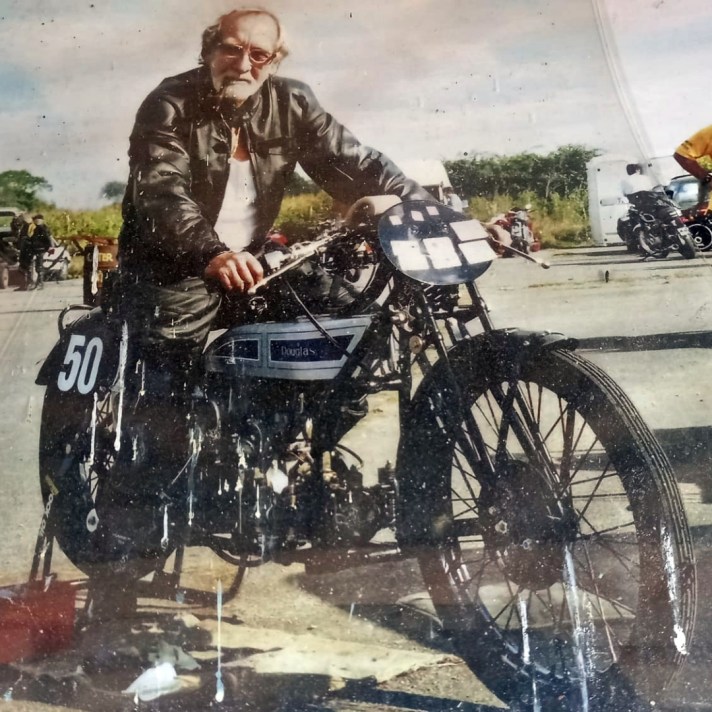
I was contacted a few days ago by a chap who has recently moved house. His new home was previously owned by a gentleman with a collection of classic cars and motorcycles, and a couple of framed photographs of a Douglas were left behind. He wondered if I knew anything about them …

Douglas OHV Sprinter

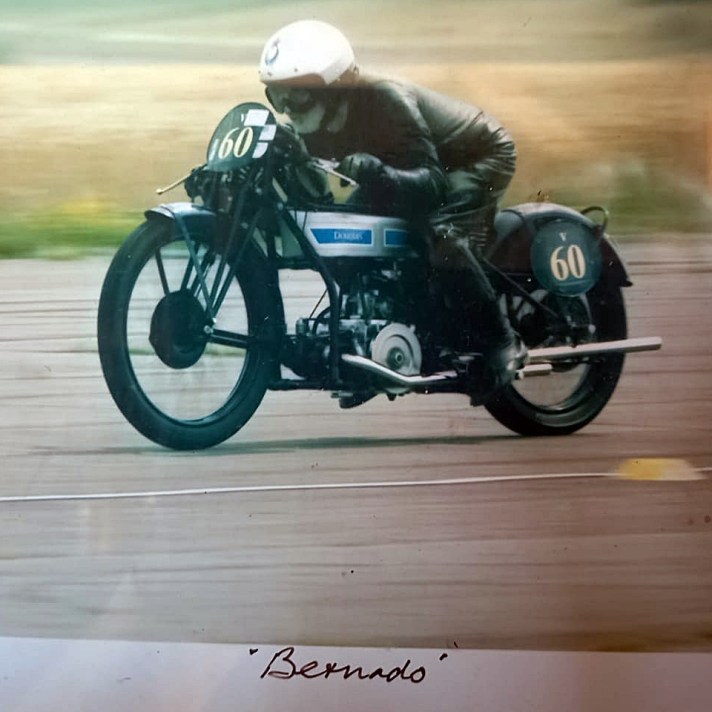
The photographs were in frames, one with the glass broken. I have ‘cleaned them up’ to improve the quality, and the machine appears to me to be a TT model or possibly an SW5, from around 1928-30. One photograph is captioned ‘Bernado’ – was this the nickname of the bike or the rider? On careful inspection the rider is smoking a pipe. At a guess, the pictures date from the1990s or early 2000s.

'Bernado' Captured at Speed
‘Bernado’ Captured at Speed

Can anyone shed any light on the machine, the rider or perhaps where the pictures were taken? It’s a distinctive machine and must have been known in sprinting or vintage racing circles at the time. Over to you …

Douglas Restoration … Knowing Where to Stop!

Those of us who enjoy pre-war machines probably know that brake lights only became compulsory – on new motorcycles – from 1st January 1936. However, they are a ‘useful’ feature on older machines. After all, explaining that the car behind ran into you because your motorcycle hasn’t got a stop light doesn’t look good on an insurance claim!
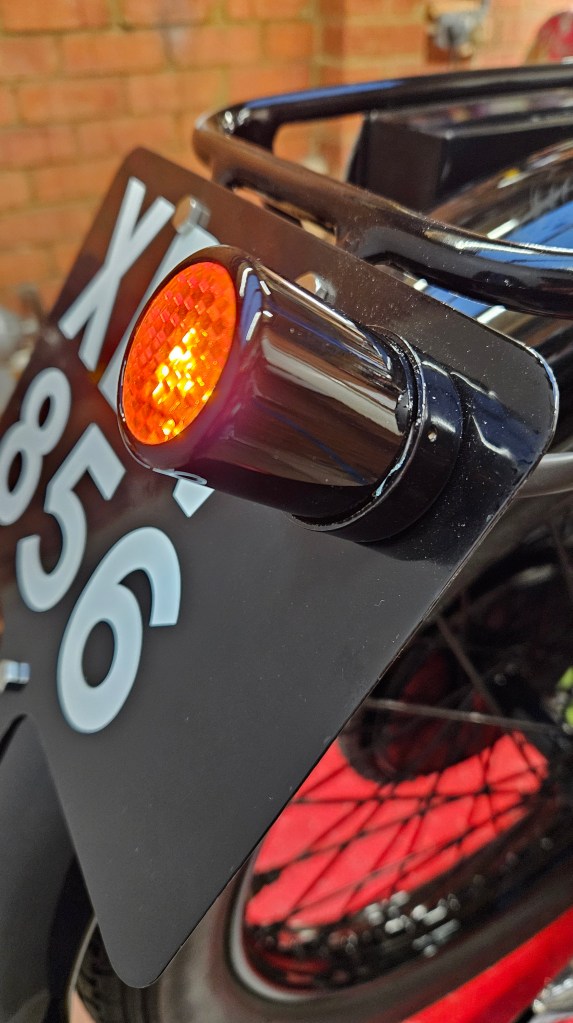
In restoring my own 1931 Douglas, I’ve tried to keep its appearance as authentic as possible. It had a period rear light but it was damaged and the red lens was missing – and it only had provision for a single filament tail lamp bulb. The lens was the easy bit – cut down from a bicycle reflector. Modifying the lamp housing to take a twin filament bulb for stop and tail lamps was more challenging. Eventually I bought a pattern ’30s style rear lamp and carefully removed the bulb holder. I did the same with the old unit and then silver-soldered the new bulb holder into the old housing. As I had to make a wiring harness as well, it was a simple matter to include wiring for a stop lamp at the same time – and include an earth lead back to the battery.
So, now I had a newly repainted lamp, a lens/reflector with a stop and tail lamp bulb – but the brightness of the lamps was less than impressive. Time for another ‘modern’ compromise. After some research I found an LED stop/tail lamp bulb that was short enough (36 mm overall) to fit inside the housing. Not only does this give excellent brightness but, with a power consumption of 0.75 W, it makes a 20 W BTH pancake dynamo look muscular! Result – a 1931 motorcycle with a rear lamp that has reasonable performance for today’s roads.

Douglas with LEDouglas Rear Number Plate with LED Lamp in Modified Period Housing
Douglas with LED Lamp in Modified Period Housing