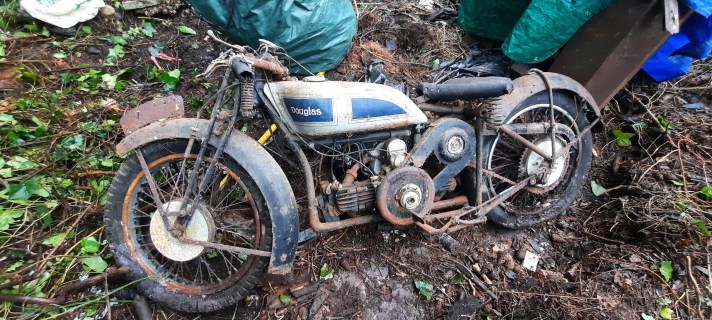
I’m often asked to help identify Douglas machines – and it can be quite a challenge. A picture is worth a thousand words, as the saying goes, – though one silver flat-tanker can look much like another. A Mk. IV looks very like a Mk. V apart from the rib in the front mudguard … However, with a basic understanding of the era from which the machine dates, frame, engine and gearbox numbers usually permit accurate identification. A guide to these numbers and where to find them can be found here.
Finally, and perhaps less obviously, for UK-registered machines the registration mark can prove invaluable. The reason for this is that most of the Douglas machines still in existence are listed in the LDMCC’s Machine Register. Armed with the registration mark and a bit of patience, it’s surprising how often ‘newly discovered’ machines are already known to the Club.
I’m sure the Club’s machine registrar could give me an accurate figure for the number of machines listed, but an informed guess would be around 4,000 – there’s a fair chance that the machine you’re trying to identify could be among them!
Mystery Douglas Sprinter
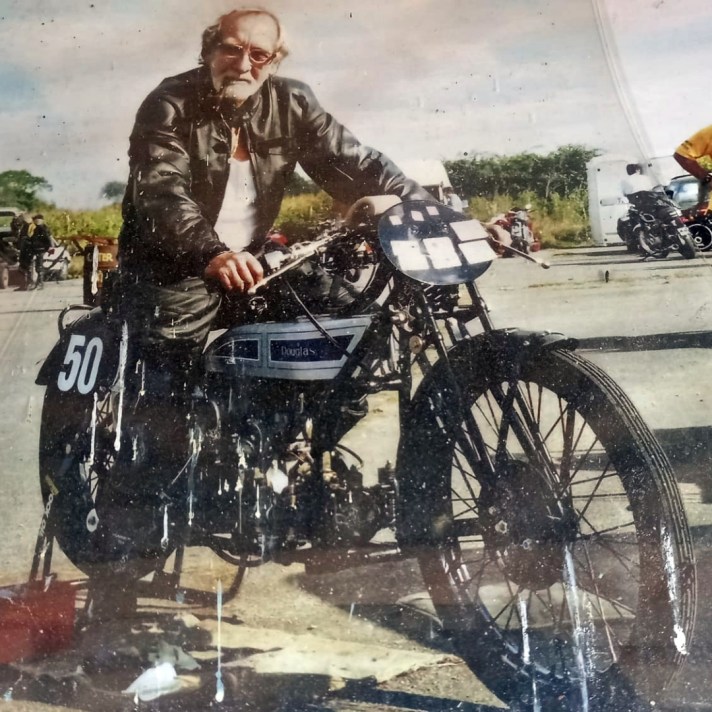
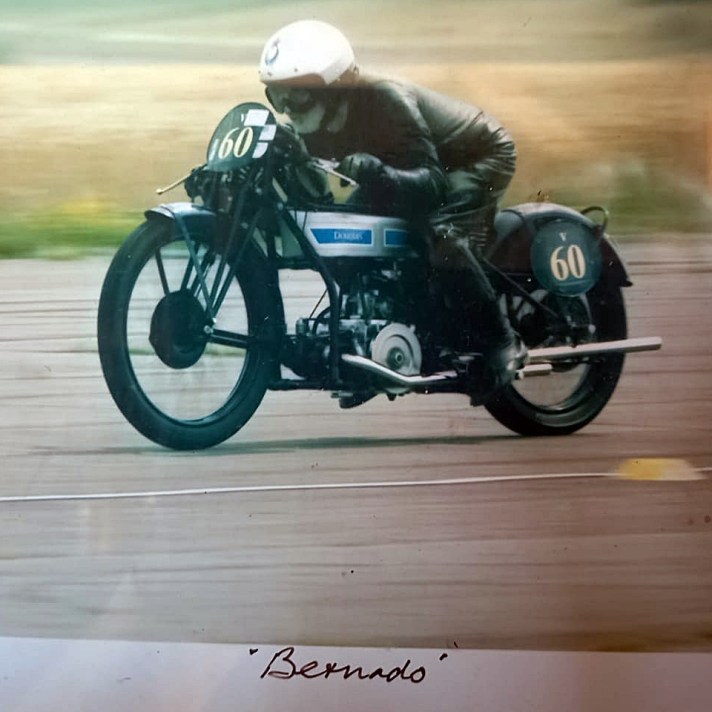
I was contacted a few days ago by a chap who has recently moved house. His new home was previously owned by a gentleman with a collection of classic cars and motorcycles, and a couple of framed photographs of a Douglas were left behind. He wondered if I knew anything about them …

The photographs were in frames, one with the glass broken. I have ‘cleaned them up’ to improve the quality, and the machine appears to me to be a TT model or possibly an SW5, from around 1928-30. One photograph is captioned ‘Bernado’ – was this the nickname of the bike or the rider? On careful inspection the rider is smoking a pipe. At a guess, the pictures date from the1990s or early 2000s.

Can anyone shed any light on the machine, the rider or perhaps where the pictures were taken? It’s a distinctive machine and must have been known in sprinting or vintage racing circles at the time. Over to you …
Douglas Restoration … Knowing Where to Stop!
Those of us who enjoy pre-war machines probably know that brake lights only became compulsory – on new motorcycles – from 1st January 1936. However, they are a ‘useful’ feature on older machines. After all, explaining that the car behind ran into you because your motorcycle hasn’t got a stop light doesn’t look good on an insurance claim!
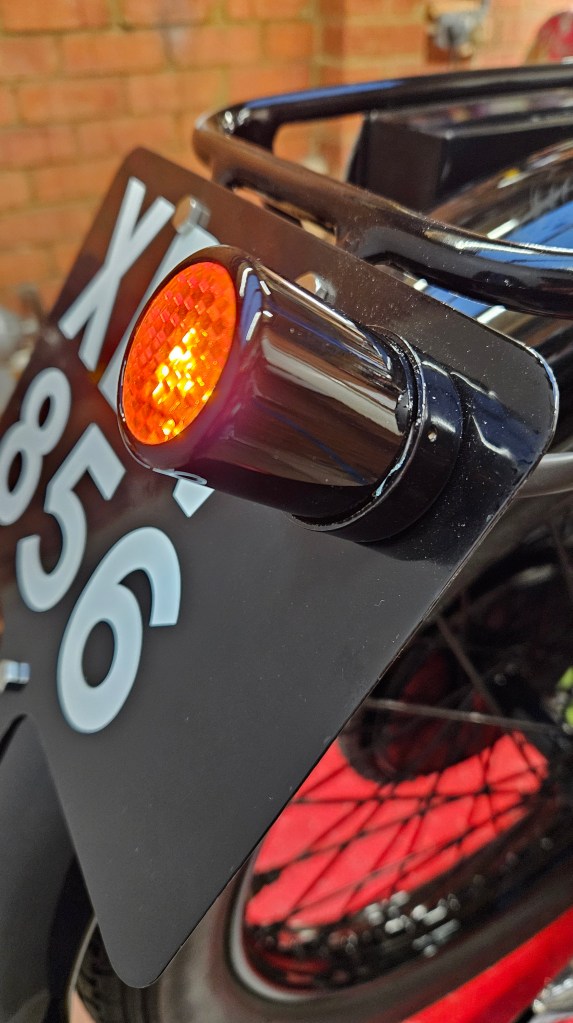
In restoring my own 1931 Douglas, I’ve tried to keep its appearance as authentic as possible. It had a period rear light but it was damaged and the red lens was missing – and it only had provision for a single filament tail lamp bulb. The lens was the easy bit – cut down from a bicycle reflector. Modifying the lamp housing to take a twin filament bulb for stop and tail lamps was more challenging. Eventually I bought a pattern ’30s style rear lamp and carefully removed the bulb holder. I did the same with the old unit and then silver-soldered the new bulb holder into the old housing. As I had to make a wiring harness as well, it was a simple matter to include wiring for a stop lamp at the same time – and include an earth lead back to the battery.
So, now I had a newly repainted lamp, a lens/reflector with a stop and tail lamp bulb – but the brightness of the lamps was less than impressive. Time for another ‘modern’ compromise. After some research I found an LED stop/tail lamp bulb that was short enough (36 mm overall) to fit inside the housing. Not only does this give excellent brightness but, with a power consumption of 0.75 W, it makes a 20 W BTH pancake dynamo look muscular! Result – a 1931 motorcycle with a rear lamp that has reasonable performance for today’s roads.

Douglas Aero – Setting the Record Straight?
I was contacted recently by a chap researching the history of the Bristol Aircraft Company, whose researches raised questions about the ownership of the Douglas business in the 1930s. For owners of machines from this era, the discussion sheds some light on the origins of the ‘Aero’ model name. The generally accepted explanation for the Aero designation is that the company was bought in June 1935 by The British Aircraft Company (BAC), and that Aero was included in the subsequent models’ names to reflect this change. But is this correct?
Mick Walker, in his book ‘Douglas – The Complete Story’, attributes this to a news item published in The Motor Cycle of 20th June 1935 which states that ‘The Douglas factory has been purchased by the British Pacific Trust (a front for BAC) …’ Their plan appears to have been to use Douglas’ manufacturing facilities to produce aircraft engines. However, contracts failed to appear and motorcycle production continued until 1939. This version of events is also to be found in Jeff Clew’s book ‘Douglas – The Best Twin’.
For readers with an appetite for historical accuracy, a history of the Douglas concern on the Kingswood Council website suggests a different version of events.
In essence, the issue boils down to the origins of Aero Engines Ltd., set up to take over the factory in June 1935. Was this company formed by BAC (not to be confused, incidentally, with the later British Aircraft Corporation of Concorde fame) or by General Aircraft Ltd., as described in the comprehensive and evidently well-researched document on the Kingswood Council website? The author of this piece, John Penny, makes a strong argument for the latter explanation.
Something for historians among us to ponder during these icy and salty months while your trusty Douglas is sitting in the garage!
Run to Twyford Waterworks
The final outing of the season – unless we get an Indian Summer – is to Twyford Waterworks, an Edwardian pumping station in the heart of rural Hampshire near Winchester. 6th October is an open day with pumps and engines running, and the cafe will be open as well. Meeting time is 12 o’clock, as usual, and the waterworks are located at Hazeley Road, Twyford SO21 1QA.