
Surrey and Hants Section members will be dusting off the cobwebs and firing up the flat twins for the first social meet of the season, on the 14th of April. Meeting time is 12 o’clock at the museum car park at Bashley Cross Road, New Milton BH25 5SZ. Everyone welcome.
Holding Charge
I was asked recently where one could buy a battery for a Dragonfly. My answer was that I didn’t know; I presume motorcycle shops still sell lead-acid batteries but clearly one cannot order them on-line to be sent through the post! I haven’t bought one in years – not since I discovered sealed AGM batteries. AGM stands for Absorbent Glass Mat and is an advanced type of lead acid battery that is sealed, spill-free, and maintenance-free. I have them on all my older machines – they are inexpensive, unaffected by vibration and appear to hold their charge almost indefinitely! Ebay offers a wide range of sizes and capacities. The only change needed is to the connectors, which are generally the Lucar spade type found on modern vehicles. So, if the Douglas is laid up for the winter and you’re wondering if the lights will still work come next spring – I can strongly recommend an AGM battery as the way forward!
Timing a Pre-War Douglas
Now, I expect everyone with a pre-war Douglas has thought of this already – but I was quite pleased with the idea!
Some of the smaller pre-war models, such as my A31, do not have a plugged drilling in the cylinder head to allow a marked rod to be used for measuring piston position, so setting the ignition timing with a degree disc is the only real alternative. Fitting a disc to the end of the crank, however, would involve removing the flywheel and primary drive, which felt like a lot of extra work. The alternative was to cut the centre out of an old degree disc and attach it to the flywheel with self-adhesive velcro pads. Clearly, it won’t fit anything else in future but it saved a lot of work!
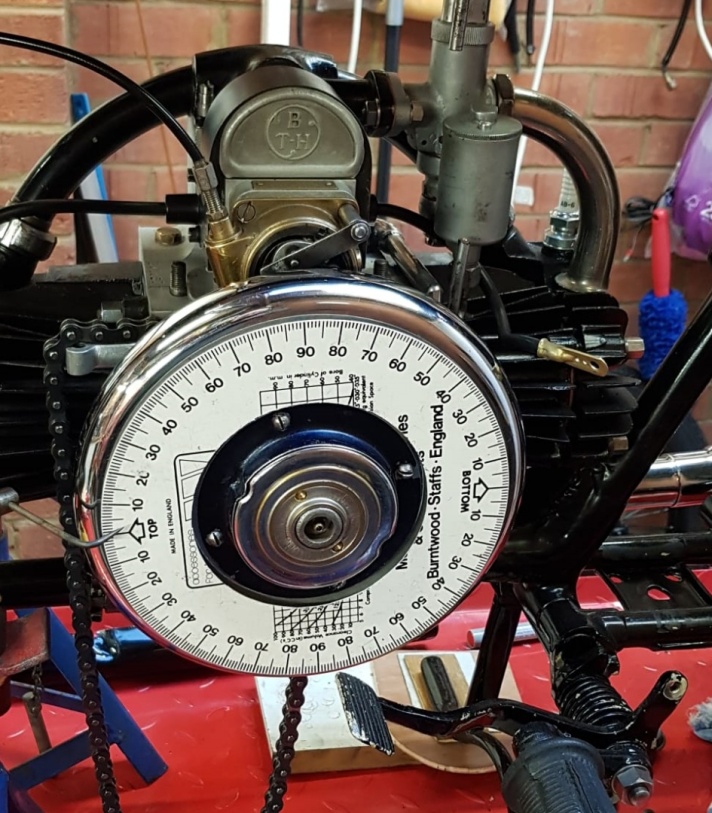
The next challenge, of course, was to establish top dead centre (TDC). Again, in the absence of a drilling in the cylinder heads, I had to improvise, using a long blunt rod through one of the valve caps to establish when the piston ‘rocked’ at the top of its stroke. After a few attempts, I think I got pretty close.
Close enough? Ultimately it’s a low-compression side valve. Accuracy is limited by the keyed drive pinion on the magneto, so it will always be ‘the closest tooth’. And, if, my crankshaft is typical, TDC differs from one piston to the other! I think it’s close enough …
Greyhound under the Hammer
Animal lovers need not look away – this is a Greyhound of the two-wheeled variety, an unusual Douglas machine from 1933. Lot 155 of H&H Classics auction on 12th July at the National Motorcycle Museum is a Douglas D33 Greyhound. The machine – APH 256 – is one of just a handful of this model known to the Club and is listed in the Douglas Machine Register.
The D33 was an updated version of the successful S6/T6 models, designed by Freddie Dixon and launched at the 1929 Olympia Show. While S5/S6 and T5/T6 models from 1930-31 are relatively common, 1933 was a year of financial turmoil for Douglas, with an official Receiver appointed in July of that year. As a result very few 1933 machines were built, with London dealers still trying to move 1932 models at heavily discounted prices.
While I do not generally feature machines at auction in this blog, this is a most unusual example of a 1930s Douglas and appears from the photographs to be in remarkably original condition. I hope that it finds a new owner and a good home – in the LDMCC, of course!
Pre-War Spares Scheme
I’m pleased to report that the Club’s Pre-War Spares Scheme will be up and running again shortly, with a planned start date of 1st March 2023. A Club member has kindly stepped forward and agreed to take on this key role – full contact details will be included in the next issue of The New Con Rod magazine, posted to Club members at the end of February. As the owner of a pre-war machine myself, I view this as a particularly positive development!
 The London Douglas Motor Cycle Club