Summer days feel rather distant already, but this brings the warmth of the 2022 show season back! Spotted at the Maldon Museum of Power show in August, this mid-’20s Model CW is a lovely example of a 1920s flat-tanker, and a credit to its owner. The all-chain drive CW, with three-speed countershaft gearbox, was an up-market version of the belt-driven two-speed model TS, and together formed the backbone of Douglas 2.3/4hp range in the mid 1920s, before the popular EW model was introduced in 1926.
I often get contacts through this website asking for help to identify or trace machines, but a recent request was to find a home for the decidedly derelict remains of two flat tank Douglas machines, located in Australia. This project was clearly not for the faint-hearted but, as the owner and I had agreed, I put an advertisement into the Club’s magazine and waited to see what would happen. To my surprise, five readers contacted me expressing an interest and the remains have now found a new home, still in Australia. The photos give some idea of just how far gone the parts are but (as I know to my cost!), the camera can lie and the reality with old metal parts is often worse than the pictures suggest.
1925 Douglas Model CW with Tank and Fittings
Crated and freighted, these two Douglases have now arrived at their new home and their owner has sent me some first thoughts. The bare frame pictured is a 1924 Model TS, while the machine with petrol tank is believed to be a Model CW from 1925.
1924 Douglas Model TS Bare Frame
This tank caused some head-scratching, until the new owner realised that it was a standard ‘box’ tank, modified at some time in its life by cutting the sides of the tank at the rear, bending the back end down and soldering a new bottom in place. Happily, the original fittings are still present and traces of the original paintwork show the Douglas name.
Douglas Flat Tanker Rear Mudguard and Rack
Clearly, with these projects, their new owner is at the foot of a mountain but I’ve asked him to keep me informed of progress. If there were a ‘back from the dead’ award for restoration work, these two machines from almost a hundred years ago would be strong contenders!
There were some fine machines on display at the VMCC’s Founder’s Day at Stanford Hall this year – but none finer, of course, than those on the Douglas stand. We had a prominent – if noisy! – position beside the main ring which ensured a steady stream of interested visitors throughout the day. Club members had brought a variety of machines from the inter-war years, showing the development from flat tank models of the 1920s to the more modern saddle tank designs of the 1930s, plus a ‘hand-crafted’ replica of a competition machine which drew some admiring glances! I particularly liked the 1929 L29 model in ‘touring trim’, ie: with leather suitcase strapped to the pillion.
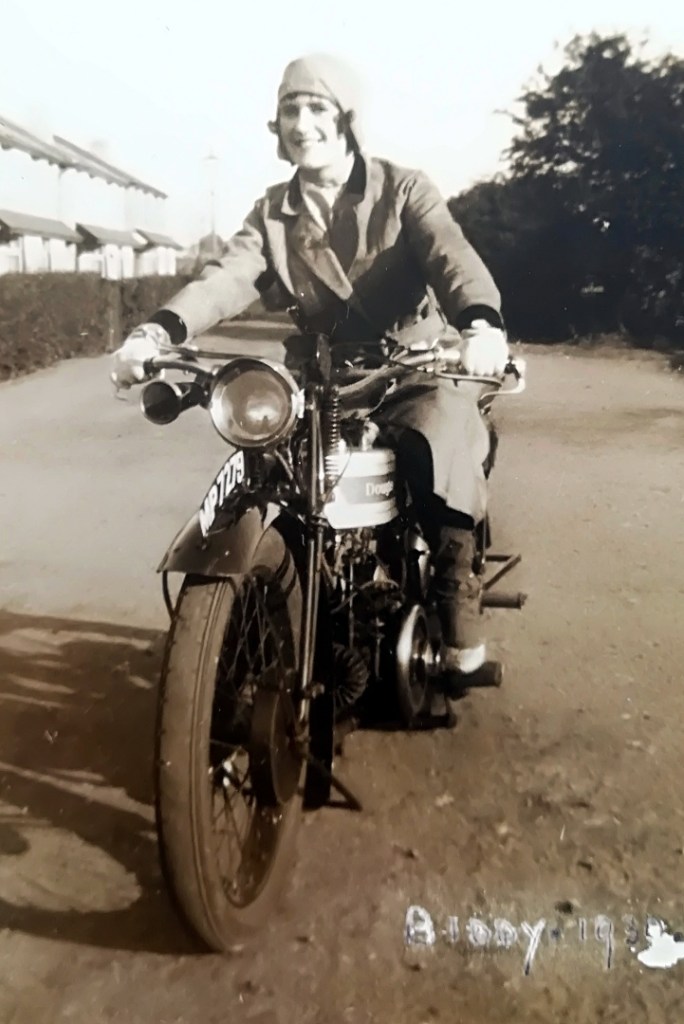
Period pictures always fascinate me, and this one was sent by a visitor to the site who found it in a book about JAP engines, purchased in a charity shop. It is captioned ‘Biddy 1930’ and he wondered if anyone could tell him more about it. MP 7279 – a Middlesex registration mark – does not show up on the DVLA site and does not appear in the Douglas Club’s records, so it seems unlikely that Biddy’s machine has survived. Perhaps the state of that front tyre had something to do with it …
Sharper eyes than mine can probably identify the model but I think it’s an EW from the late 1920s. If you can identify the machine, the location, or even the rider – do leave a comment below.
Douglas S1 – Ridden by Cyril Pullin at Brooklands, 1922?
A visitor to the site has kindly sent me two old photographs to forward to the Club’s archive – but they are too good not to feature here first! The photo above looks like a ‘works’ shot – but it’s the captions which intrigued me. It appears to have been displayed in an exhibition, and is captioned ‘Cyril Pullin’s 100 MPH Douglas‘. On the reverse, in pencil, someone has added ‘23rd March 1922 Brooklands 100.06 mph. 3.1/2 HP 494cc OHV Model S1, 68mm x 68mm. Les Bailey / Cyril Pullin. Cyril Pullin became chief designer.’
The S1 was, according to Mick Walker’s ‘Douglas – The Complete Story’, the star performer of the 1921 range. It was the first series production OHV model from Douglas and featured all-chain drive, a three-speed box, ‘efficient’ brakes and a ‘special heated induction system’ – possibly the sleeve and vertical pipe visible in the photograph, behind the carburettor? At £130, it was an expensive machine for the early 1920s.
But was this really the Brooklands racer? The mudguards, rear wheel with belt rim, rear stand and front number plate do not suggest a racing machine, yet the dropped bars and that impressive oil tank under the seat definitely do. More intriguingly, the front wheel is fitted with Douglas’ early disc brake with cable-operated aluminium caliper. But – the disc brake (more accurately, an inverted vee lined with friction material) did not appear until 1924, when it was fitted on the RW and RA models at the front and rear. At the rear, this machine is fitted with what looks like Douglas’ 8-inch servo-operated brake, which appeared on production machines in the middle of the decade.
So, I’m slightly puzzled by this ‘record breaker’! If you can shed any light on the story, please use the ‘Comment’ box below to let us know.



 The London Douglas Motor Cycle Club